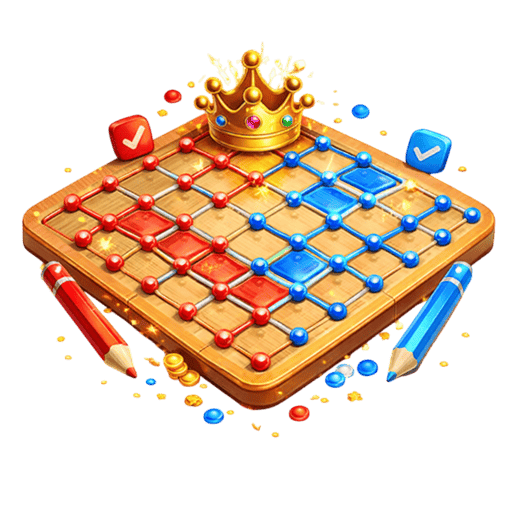
Dots and Boxes looks like a children's game — connect dots, complete boxes, most boxes wins. But beneath this simple exterior lies one of the deepest two-player strategy games ever designed. Mathematicians have studied it extensively, and the strategy involves concepts from combinatorial game theory.
Here's how to go from casual player to someone who wins almost every game.
The Basics
Two players take turns drawing a single horizontal or vertical line between adjacent dots on a grid. When a player completes the fourth side of a box, they claim that box and take another turn. The player with the most boxes when all lines are drawn wins.
The critical rule: when you complete a box, you get an extra turn. This creates chain reactions where completing one box forces you into completing the next.
Beginner Strategy: The Third-Side Rule
The most important beginner principle: never draw the third side of any box unless you're forced to.
You can play this game for free on Android and iOS — no ads, no purchases required.
Why? When a box has three sides, your opponent will draw the fourth side, claim the box, and get a free turn. You're essentially giving them a point.
Practice this: Before drawing any line, scan the board for boxes with exactly two sides completed. Drawing near those boxes is safe. Drawing a line that creates a third side is almost always a mistake.
Intermediate Strategy: The Sacrifice
Sometimes you must give your opponent a box. When this happens, sacrifice strategically:
- Give away the smallest possible group of boxes
- Preferably sacrifice exactly 2 boxes in a short chain
- This forces your opponent to "open" a longer chain for you
The sacrifice play is counter-intuitive — voluntarily giving away points to gain a larger advantage. But it's the foundation of advanced Dots and Boxes play.
The Double-Cross
The most important intermediate technique. When your opponent gives you a chain of boxes:
- Claim all boxes in the chain except the last two
- Complete the second-to-last box by drawing its third side (not fourth)
- Your opponent is forced to take those last 2 boxes
- But now they must open the next chain for you
This "double-cross" lets you control who opens each chain. The player who controls chain openings controls the game.
Advanced Strategy: Chain Parity
At the expert level, Dots and Boxes is entirely about chain parity — whether the total number of chains on the board is odd or even.
What Is a Chain?
A chain is a sequence of connected boxes where completing one leads to completing the next. Chains can be:
- Short chains: 1-2 boxes (sacrificeable)
- Long chains: 3+ boxes (valuable)
The Parity Rule
- If the number of long chains is odd, the player who moves first in the chain phase wins
- If the number of long chains is even, the second player in the chain phase wins
Advanced players manipulate the board during the early and middle game to create favorable chain parity for the endgame.
Game Phase Strategies
Opening (First 30% of Lines)
- Draw lines in the board interior, away from edges
- Avoid creating third sides
- Focus on maintaining flexibility
- Count potential chains forming
Middle Game (30-70% of Lines)
- Begin identifying chain structures
- Make sacrifice decisions — which small chains to concede
- Manipulate chain parity through strategic line placement
- Force your opponent into unfavorable positions
Endgame (Last 30% of Lines)
- Execute double-cross technique on every chain
- Claim long chains while forcing opponent to open the next
- Count boxes carefully — sometimes taking a shorter chain is optimal if it gives you parity control
Common Mistakes
Mistake 1: Greedily Taking Every Box
Taking every available box feels good but often loses the game. The double-cross sacrifice of 2 boxes can win you 10.
Mistake 2: Random Line Placement
Every line should be intentional. Random lines in the early game create uncontrollable chain structures that favor your opponent.
Mistake 3: Ignoring Chain Formation
By the middle game, you should be tracking chain structures. Ignoring them means the endgame is decided by luck rather than skill.
Mistake 4: Playing Too Fast
Dots and Boxes rewards careful thought. Take 10-15 seconds per move to assess the impact of each line on chain parity and box completion.
Mistake 5: Fear of Sacrifice
New players avoid giving away any boxes. Experienced players know that controlled sacrifice is the path to winning more boxes overall.
Grid Size and Strategy Depth
| Grid Size | Boxes | Strategy Depth | Best For | | --------- | ----- | -------------- | -------------------- | | 3×3 | 9 | Low | Learning basics | | 4×4 | 16 | Medium | Casual play | | 5×5 | 25 | High | Competitive play | | 6×6 | 36 | Very High | Expert-level matches |
Larger grids create more chains and more opportunities for strategic manipulation. Start with 3×3 to learn, then progress to 5×5 for the full strategic experience.
See the full game collection or learn about Playtua's features.
Keep Reading
Related Strategy Games
- Tic Tac Toe — Fundamental strategic thinking
- Ludo King — Strategy mixed with probability
- Connect Em All — Spatial constraint puzzles
- 2048 — Multi-step strategic planning
📱 Download Playtua — App Store · Google Play — Play Dots and Boxes free against AI or pass-and-play with friends.