How to Play Dots and Boxes
Connect dots to complete boxes - classic strategy game vs AI!
What is Dots and Boxes?
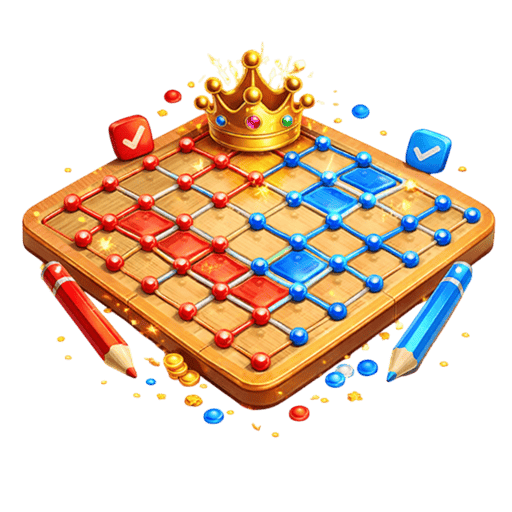
Dots and Boxes is a classic pen-and-paper strategy game brought to life digitally with smart AI opponents. Take turns connecting adjacent dots with lines, and when you complete the fourth side of a box, you claim it and earn another turn. The player with the most boxes at the end wins. This deceptively simple game hides remarkable strategic depth — every line you draw affects the entire board, and one wrong move can hand your opponent a chain of boxes. Mastering the concepts of chains, sacrifices, and double-dealing makes Dots and Boxes one of the most intellectually rewarding strategy games available. Perfect for brain training, competitive play, or casual fun!
Master the art of strategic thinking with Dots and Boxes on Playtura! This beloved pen-and-paper classic has been beautifully reimagined for mobile with clean visuals, smart AI opponents, and multiple grid sizes. Every line you draw matters as you compete to claim the most boxes. The game rewards forward thinking — learn to control chains, sacrifice small groups for larger gains, and set traps that force your opponent to give you boxes. Choose from multiple grid sizes (3x3 to 6x6) and AI difficulty levels for the perfect challenge. Whether you’re a strategy game veteran or discovering this classic for the first time, Dots and Boxes delivers endless brain-teasing entertainment. Download Playtura and play free, offline, with minimal ads! Go ad-free with Premium.
Step-by-Step Guide to Play Dots and Boxes
- 1
Tap between two adjacent dots to draw a connecting line
- 2
Complete the fourth side of a box to claim it (it turns your color)
- 3
Completing a box earns you an extra turn — chain multiple boxes!
- 4
The player with the most claimed boxes when all lines are drawn wins
- 5
Think ahead — avoid drawing the third side of a box (it gives your opponent the claim)
- 6
Use chain strategy: force your opponent to open up multiple boxes for you
- 7
Try different grid sizes for varying levels of strategic depth
Dots and Boxes Features
Pro Tips & Winning Strategies
Never draw the third side of a box unless you're setting up a chain
Force your opponent to open chains by controlling the board's parity
Control the center of the board — it connects to more potential boxes
Count remaining boxes to plan your endgame strategy
Sacrifice small chains (1-2 boxes) to gain control of larger chains
Learn the "double-dealing" technique to keep control between chains
Start with smaller grids to learn chain strategy before tackling larger ones
Benefits of Playing Dots and Boxes
Frequently Asked Questions
What are the step-by-step rules of Dots and Boxes?
What strategies help win at Dots and Boxes?
How long does a typical Dots and Boxes session take?
Is Dots and Boxes suitable for beginners?
What cognitive benefits does playing Dots and Boxes provide?
More Game Guides

Explore More
Ready to Play Dots and Boxes?
Download Playtura now — Dots and Boxes plus 50+ other amazing games, completely free!
Download Playtura Free